



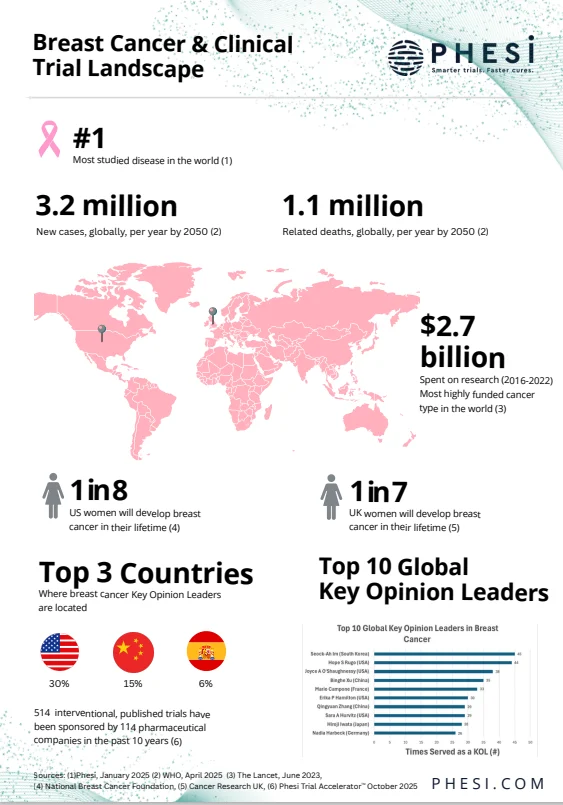
On World Breast Cancer Day 2025, Phesi released new data revealing that breast cancer clinical trial expertise is disproportionately concentrated in just two countries – the US and China – while lower-income countries continue to suffer from increasing mortality rates. Phesi analysed 514 interventional, published trials sponsored by 114 pharmaceutical companies in the past ten years, drawing from 19,321 records in Phesi’s Trial Accelerator platform. Phesi identified 256 Key Opinion Leaders (KOLs) across 24 countries who have led more than five clinical trials each. Of those 256 KOLs, 76 (30%) are based in the US and 39 (15%) in China. That means that 45% of all leading breast cancer KOLs identified are based in just two countries, with Spain, Japan and Germany rounding out the top 5.
“While it is encouraging to see so much research activity, the data clearly show that patients in regions where breast cancer mortality is increasing lack access to innovative clinical trials,” said Dr Gen Li, President, Phesi. “Today, we have a much deeper understanding of the molecular subtypes of breast cancer, including Luminal A and B, HER2-positive and Triple-Negative. When this knowledge is coupled with advances in AI and clinical data analytics, trial sponsors can select relevant investigator sites and KOLs with far greater precision. This has two clear benefits. Firstly, more efficient and successful trials with increased ROI. But secondly and most importantly, it ensures breast cancer clinical development is patient-centric and distributed equitably around the globe.”
Phesi’s analysis underscores the lack of access to breast cancer experts and clinical trials in countries with a low Human Development Index (HDI). This compounds issues highlighted by recent data from the World Health Organization’s International Agency for Research on Cancer (IARC), which showed that by 2050 there will be 3.2 million new breast cancer cases and 1.1 million breast cancer-related deaths per year, with the increase disproportionately affecting low HDI countries. The concentration of KOLs and trials in specific regions also suggests that sponsors are repeatedly using the same investigator sites – despite the risk of investigator sites becoming overburdened and without considering alternatives in regions that may better suit their trial.
“Breast cancer is a complex disease represented by multiple biomarkers and being able to identify experts in specific forms of breast cancer is critical,” said Jonathan Peachey, COO, Phesi. “Increasingly, we are seeing sponsors that recognise this shift turn to AI-driven clinical data analytics to make their trials more targeted and effective. With this data-driven approach, sponsors can leverage Patient Access Scores and Digital Patient Profiles to precisely profile both patients and investigators. The most sophisticated approaches will use the huge volume of real-world breast cancer patient data available to create digital twins to simulate trials and predict outcomes. In doing so, we are confident the industry can uncover faster cures, for more types of breast cancer, for more patients.”
