



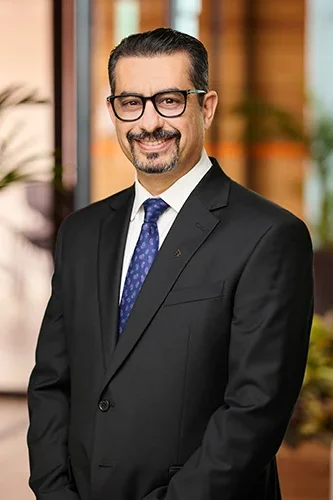
Al-Futtaim Health provides comprehensive healthcare services through its HealthHub clinics, ensuring high-quality, accessible care for individuals and families. It has 19 clinics across Dubai. Dr Haider Al Enzi, Managing Director at Al-Futtaim Health, discusses the company’s long-term vision for transforming healthcare in the UAE and how it aims to create a new benchmark for healthcare that is both excellent and equitable. He also discusses digital health technologies and the role of analytics.
What is Al-Futtaim Health’s long-term vision for transforming healthcare in the UAE and the wider region?
Our long-term vision is to be a leader in transforming healthcare by making premium, high-quality care both accessible and affordable for communities across the UAE and the wider region. The way we are doing this is by fundamentally challenging the traditional healthcare model, with our approach built on three pillars: efficiency, quality and affordability. For efficiency, we’ve optimised our operations to ensure a smoother patient journey, aiming to be faster than other clinics. For quality, we’ve invested heavily in our facilities, staff and technology, a commitment that has been externally validated by our platinum-level accreditation from Accreditation Canada.
Finally, by focusing on a scalable community-based model, we can offer this high-quality care at a more affordable price point, making it reachable for a broader segment of the population. This vision is about creating a new benchmark for healthcare that is both excellent and equitable.
How does Al-Futtaim Health align its strategy with the broader goals of Al-Futtaim?
Our purpose is to improve the lives of the communities we serve, and we achieve this by focusing on wellbeing and health. We go beyond treating illnesses; we aim to keep people healthy through a multi-faceted approach. We provide patient-focused care that is tailored to individual needs and run extensive preventive programmes, such as community wellness campaigns and chronic disease management initiatives, which are designed to enhance the quality of life and reduce the burden of disease.
While many healthcare providers are expanding their investments and services to meet the needs of the growing affluent segment of the expatriate population, we remain equally focused on supporting the long-standing middle-income communities in the UAE. Our goal is to ensure that preventive healthcare is accessible, inclusive and tailored to the needs of all segments of society. This reflects the group’s wider mission: to create a positive and lasting impact on the lives of people, ensuring that our communities not just live, but thrive.
What are the most significant trends in healthcare that you’re seeing at the moment?
We’re observing several significant trends that are reshaping the healthcare landscape. The first and most impactful is the massive, ongoing shift towards Digital Transformation, encompassing everything from the rise of telehealth and remote monitoring to the use of AI in diagnostics and operational efficiency.
The second trend is the growing emphasis on preventive health and wellness. People are becoming more proactive about their health, and the healthcare industry is responding by offering more services focused on early detection, wellness programmes and chronic disease management.
Another important trend is the increasing access to information among patients, driven by digital platforms and emerging AI tools. While this empowers individuals to take a more active role in their health, it also places a greater responsibility on healthcare providers to guide them through complex medical information. Our clinicians are now engaging in more in-depth consultations, helping patients understand the evidence behind clinical decisions.
Finally, we’re seeing a move towards a truly patient-centric model. Patients are no longer passive recipients of care; they are active participants. They demand convenience, transparency and a personalised experience, which is why we put so much effort into our patient experience department.
How is Al-Futtaim Health leveraging digital health technologies?
Our journey began with the ‘Smart Clinic’ in 2022, and although that particular model was a learning experience, we have since integrated successful and scalable technologies. A core component of our digital strategy is our robust teleconsultation platform, which is fully embedded within our HealthHub services, allowing patients to have remote consultations with our highly experienced doctors.
To ensure we are evolving with the needs of our patients, we have integrated an advanced AI-powered tool across our system. The Solventum AI tool is a speech recognition system that streamlines clinical documentation, allowing doctors to focus their attention on the patient rather than their computer screen.
We are also implementing an AI solution to improve our insurance claims submission process, enabling faster turnaround times. In addition, we have started piloting a ‘Computer Vision’ AI solution that provides insights into clinic footfall patterns, peak hours and heat maps, allowing us to optimise operations and improve efficiencies. We are also testing AI tools for radiology imaging, which assist doctors by suggesting possible diagnoses based on a vast database of clinical cases, along with several other AI-driven use cases currently under evaluation. Our commitment is to remain at the forefront of digital health innovation.
What role does data analytics play in enhancing patient care and operational efficiency?
Data analytics is essential to the success of our operations, acting as the intelligence behind our decision-making. In terms of patient care, we use data to identify trends and patterns in patient health, which allows us to provide more personalised and proactive care. For example, by analysing patient data, we can better manage chronic diseases and tailor our preventive programmes to the needs of the community.
From an operational standpoint, data analytics are invaluable for enhancing our efficiency. We use it to monitor key performance indicators, such as patient waiting times and resource allocation. This allows us to make data-driven improvements to our processes, ensuring we can deliver on our promise of being faster and more efficient.
How does Al-Futtaim Health ensure high levels of patient satisfaction and trust across its facilities?
The nature of healthcare means that patient satisfaction and trust are paramount, and we have a dedicated approach to ensuring we consistently deliver this. I personally established a dedicated Patient Experience department to centralise and manage this critical aspect of our business. This team is responsible for collecting feedback through various channels, including surveys, reviews and direct complaints.
The data we collect is meticulously analysed, and our improvement plans are directly derived from this feedback. We use this feedback to drive tangible changes in our clinics, from staff training to facility upgrades. Our goal is to create a culture of continuous improvement, where every member of our team understands that patient satisfaction is our top priority.
Are there any recent or upcoming collaborations with global healthcare or tech companies?
We are actively pursuing collaborations that align with our vision of using technology to enhance healthcare. A significant recent milestone is our implementation of the Solventum AI tool, an advanced speech recognition system for clinicians. This collaboration, which became fully operational in 2025, helps our doctors document patient visits more efficiently, allowing them to focus more on the human connection during consultations.
Are there plans to expand Al-Futtaim Health in the UAE?
Our current plan is ambitious and a direct reflection of the growing demand for our services. We have a clear and confirmed plan to open 10 new branches by 2027, significantly increasing our capacity and making our high-quality, patient-centric healthcare model accessible to even more communities across the country. In parallel, we have begun planning for a hospital that will introduce inpatient services and serve as a central hub for our existing clinics, further enhancing our integrated care model.
